What Are Lead Generation Tools and Why You Need Them
Lead generation tools are software platforms that help businesses find, attract, and convert potential customers into qualified sales prospects. They automate the entire process from identifying leads to nurturing them through the sales funnel. Using the right lead generation tools can dramatically boost your conversion rates, save time, and scale your business faster than manual methods ever could.
Running a business means constantly chasing new customers. But finding the right people to sell to can feel like searching for a needle in a haystack. That is where lead generation tools come in.
These platforms do the heavy lifting for you. They find potential customers, organize their information, and even help you reach out. Whether you run a small startup or a large enterprise, lead generation tools can save you time, money, and a lot of frustration. In this guide, we will break down exactly what these tools are, how they work, and why every business needs them.
Key Takeaways
- Lead generation tools automate prospecting: They save hours of manual research and outreach every week.
- They improve lead quality: Advanced filtering and scoring ensure your sales team focuses on the right prospects.
- Multiple types exist for different needs: From email tools to CRM platforms, there is a solution for every business model.
- They integrate with your existing stack: Most tools connect seamlessly with CRM, email, and marketing platforms.
- Small businesses benefit just as much: Affordable options make lead generation tools accessible to startups and SMBs.
- They provide measurable results: You can track ROI, conversion rates, and pipeline growth in real time.
📑 Table of Contents
What Are Lead Generation Tools?
At their core, lead generation tools are software applications designed to help businesses identify and attract potential customers. They pull data from various sources, filter it based on your ideal customer profile, and give you a list of people or companies who might be interested in what you sell.
Think of them as your digital sales assistant. Instead of spending hours scrolling through LinkedIn or cold-calling random numbers, you let the tool do the work. It finds prospects, scores them based on how likely they are to buy, and hands them to your sales team ready to go.
The best lead generation tools combine multiple functions into one platform. You might find email outreach features, CRM integration, lead scoring, and analytics all in a single dashboard. This saves you from juggling five different apps just to run a basic prospecting campaign.
How Do Lead Generation Tools Work?
Most lead generation tools follow a simple process. First, they gather data from public databases, social media, websites, and other online sources. Then they let you filter that data using criteria like industry, company size, job title, or location.
Next, the tool scores each lead based on how well it matches your ideal customer. This process is called lead scoring. Higher-scoring leads get priority in your sales pipeline. Finally, the tool helps you engage these leads through email sequences, ads, or direct outreach.
Some advanced platforms also use artificial intelligence to predict which leads are most likely to convert. This means you spend less time chasing dead ends and more time closing deals.
Why Every Business Needs Lead Generation Tools
You might wonder if you really need these tools. Can you not just do things the old-fashioned way? The truth is, lead generation tools give you a massive advantage. Here is why they matter.
They Save You Precious Time
Manual prospecting is painfully slow. Spending three hours researching a single potential client is not sustainable. Lead generation tools cut that time down to minutes. They automatically pull contact details, company information, and behavioral data so you can focus on selling instead of searching.
They Improve Your Conversion Rates
When you target the right people with the right message, conversions go up. These tools help you identify qualified leads — people who are genuinely interested and have the budget to buy. This means fewer wasted calls and more closed deals.
They Scale Your Efforts
As your business grows, your prospecting needs grow too. Lead generation tools scale with you. Whether you need 10 new leads a week or 100, these platforms handle the volume without breaking a sweat. You can expand your reach without hiring an entire new sales team.
They Provide Valuable Data and Insights
Every lead generation tool comes with analytics. You can see which campaigns are working, which messages resonate, and where your pipeline is strongest. This data helps you make smarter decisions and continuously improve your approach.
Types of Lead Generation Tools
Not all lead generation tools are the same. Different types serve different purposes in your sales and marketing funnel. Let us break them down.
Email Outreach Tools
Email remains one of the most effective ways to reach prospects. Email outreach tools help you send personalized messages at scale. They automate follow-ups, track opens and clicks, and manage your entire email sequence from one place.
Popular examples include platforms that let you build email sequences, personalize each message with the prospect’s name and company, and track replies automatically. These tools are essential for outbound marketing campaigns.
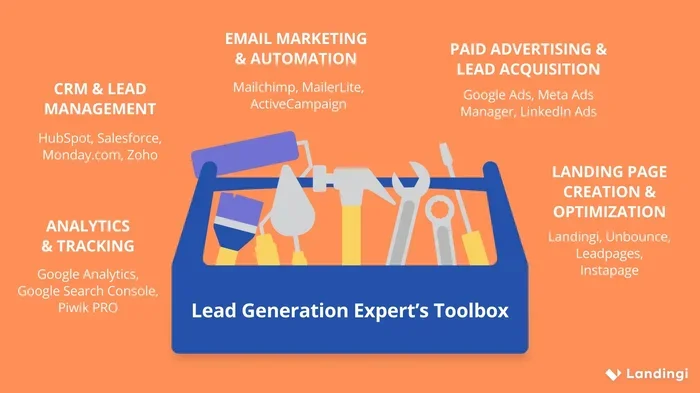
CRM and Pipeline Management Tools
A CRM (Customer Relationship Management) system is the backbone of any sales operation. It stores all your lead information, tracks interactions, and helps you manage your sales pipeline from first contact to closed deal.
Many lead generation tools integrate directly with your CRM. This means every new lead flows seamlessly into your system without manual data entry. Your team always has up-to-date information at their fingertips.
Marketing Automation Platforms
These platforms combine lead generation with marketing efforts. They help you create landing pages, run email marketing campaigns, and nurture leads automatically. When a prospect fills out a form or downloads a lead magnet, the tool captures that information and starts a tailored follow-up sequence.
Marketing automation is especially powerful for inbound marketing strategies where you attract leads through content, SEO, and social media.
Social Media and LinkedIn Tools
LinkedIn is a goldmine for B2B lead generation. Specialized tools let you search for prospects by industry, title, and company size. They also automate connection requests and messages, making it easy to build a network of potential customers.
These prospecting tools save you from the tedious work of manually browsing profiles. They also provide insights into your target audience’s interests and behavior, helping you tailor your approach.
Data Enrichment and Verification Tools
Clean data is the foundation of good lead generation. Data enrichment tools take the contact information you already have and fill in the gaps. They add job titles, company details, phone numbers, and social profiles to your database.
Verification tools check that email addresses are valid and active. This reduces bounce rates and keeps your sender reputation healthy. Both types of tools are essential for maintaining a high-quality prospect list.
Key Features to Look For
Not all lead generation tools are created equal. When shopping for one, here are the features you should prioritize.
- Targeting and filtering: The tool should let you narrow down prospects by industry, location, company size, job title, and more.
- Lead scoring: Look for tools that automatically rank leads based on their likelihood to convert.
- CRM integration: Seamless sync with your existing CRM saves time and prevents data loss.
- Email deliverability: High delivery rates and spam avoidance features are critical for outreach campaigns.
- Analytics and reporting: You need clear dashboards that show your conversion rates, pipeline progress, and ROI.
- Ease of use: The best tools are intuitive. Your team should be able to start using them within minutes, not days.
- Compliance: Make sure the tool follows data privacy regulations like GDPR and CAN-SPAM.
Budget Considerations
Price is always a factor. Lead generation tools range from free plans with limited features to enterprise solutions costing hundreds of dollars per month. Start by identifying your needs and budget. Small businesses often do well with affordable monthly plans that offer core features like email outreach and basic CRM integration.
Remember, the cheapest option is not always the best. Look for tools that offer the features you actually need. A tool packed with features you will never use is a waste of money.
How to Choose the Right Lead Generation Tool
Choosing the right lead generation tool can feel overwhelming with so many options on the market. Here is a simple framework to help you decide.
Step 1: Define Your Goals
What do you want to achieve? More sales leads? Higher conversion rates? Better pipeline management? Write down your top three goals before you start evaluating tools. This keeps you focused and prevents decision paralysis.
Step 2: Know Your Audience
Who is your ideal customer? B2B companies need different tools than B2C businesses. A B2B lead generation tool might focus on LinkedIn integration and company data, while a B2C tool might emphasize social media ads and landing pages.
Step 3: Test Before You Commit
Most quality lead generation tools offer free trials or demos. Take advantage of these. Test the interface, try importing your existing contact list, and see how the scoring and outreach features work in practice.
Step 4: Check Integration Options
Your lead generation tool should play nicely with your existing software stack. Check that it integrates with your CRM, email platform, and any other tools you rely on daily. Poor integration means extra manual work and frustrated team members.
Step 5: Read Reviews and Ask for Recommendations
Real user reviews give you honest insights into a tool’s strengths and weaknesses. Ask peers in your industry what they use and what they recommend. Word-of-mouth remains one of the best ways to find reliable software solutions.
Common Mistakes to Avoid
Even with the best lead generation tools, mistakes can derail your efforts. Here are the most common pitfalls and how to avoid them.
- Buying cheap contact lists: Pre-made lists often contain outdated or irrelevant contacts. They hurt your deliverability and waste your time.
- Ignoring data hygiene: Dirty data leads to bounced emails and missed opportunities. Clean your database regularly using verification tools.
- Over-automating outreach: Sending too many messages too fast looks spammy. Keep your outreach natural and personalized.
- Neglecting lead nurturing: Not every lead is ready to buy immediately. Use lead nurturing sequences to stay top of mind until they are.
- Skipping analytics: If you are not tracking your results, you are flying blind. Review your data weekly and adjust your strategy accordingly.
Final Thoughts
Lead generation tools are no longer a luxury — they are a necessity. In today’s competitive business landscape, manual prospecting simply cannot keep up. These platforms give you the speed, precision, and scale you need to grow consistently.
Whether you are a solo entrepreneur or a sales team of fifty, the right lead generation tool can transform your results. Start small, focus on your goals, and invest in tools that integrate well with your existing workflow. The time you save and the deals you close will more than justify the investment.
Take action today. Explore your options, run a few trials, and find the tool that fits your business. Your future customers are out there waiting — lead generation tools help you find them faster and smarter.
For instance, if your business serves clients in trades and equipment industries, you may want to explore resources on specialized topics too, like what size hose to use with air compressor to better serve those clients with the right equipment knowledge.
Frequently Asked Questions
What are lead generation tools used for?
Lead generation tools are used to find, qualify, and engage potential customers for your business. They automate the process of identifying prospects, collecting their contact information, and initiating outreach. These tools help sales and marketing teams build a healthy pipeline of interested buyers without spending hours on manual research.
How much do lead generation tools cost?
Prices vary widely depending on the features and scale. Basic plans can start as low as $20 to $50 per month, while enterprise solutions may cost several hundred dollars monthly. Most providers offer tiered pricing based on the number of users, contacts, or messages allowed. Always check what features are included at each price level before committing.
Can small businesses benefit from lead generation tools?
Absolutely. Small businesses often benefit the most because they have limited time and resources. Lead generation tools level the playing field by automating tasks that would otherwise require a full-time employee. Many affordable options are designed specifically with startups and small teams in mind.
What is the difference between inbound and outbound lead generation?
Inbound lead generation focuses on attracting prospects through content, SEO, and social media. Outbound lead generation involves reaching out directly to potential customers through email, calls, or ads. Most lead generation tools support both approaches, but some specialize in one or the other.
Do lead generation tools really work?
Yes, when used correctly. The effectiveness depends on choosing the right tool for your needs, maintaining clean data, and personalizing your outreach. Businesses that combine lead generation tools with a solid strategy consistently see higher conversion rates and faster sales cycles compared to those relying on manual methods alone.
What should I look for in a lead generation tool?
Look for accurate data, easy integration with your CRM, good email deliverability, lead scoring capabilities, and a user-friendly interface. Also consider the tool’s compliance with data privacy laws and the quality of customer support. Reading user reviews and testing free trials helps you make a confident choice.
=== CONCLUSION ===
Lead generation tools are essential for any business that wants to grow in today’s fast-paced market. They automate the tedious parts of prospecting, improve the quality of your leads, and give you the data you need to make smarter decisions. From email outreach platforms to full CRM systems, there is a lead generation tool out there for every business type and budget.
The key is to start with clear goals, choose tools that fit your workflow, and avoid common mistakes like buying bad data or neglecting your pipeline. Invest the time to learn your chosen platform inside and out. The return on investment from lead generation tools compounds over time, giving you a steady stream of qualified prospects and more closed deals.
Take the next step today. Research your options, run a trial, and experience the difference that the right lead generation tools can make for your business.